Five wounds hiding under today's dashboards.
Ordered by blast radius — from individual frustration to organisational risk.
Not a catalog. Not observability. Not a semantic layer.
Each existing category answers one third of the question. We join them.
The other three remain underneath us — we don't replace them, we make them answerable to the business.
“No one is truly gone
while they’re still remembered.”
A data asset lives by the same rule.
What it is, knows, can do
constraints · skills it enables
Who uses it, how it drifts
drift signals · trust score
Every skilled engineer has these two sides too. When they leave, the subjective side walks out —
unless the graph has already learned to remember.
We build the memory layer — and because it’s a graph, AI agents can walk it, not just humans.
What the platform actually does.
Every scene below runs in the app. Click “Run this” to load the exact URL state on your own seed data.
One conversation. Every answer the graph already knows.
Kai is the AI concierge on top of the memory layer — the single entry to everything that follows. Natural-language routing, voice-ready, and the same door that downstream agents use to query the graph. Whatever a human asks, a bot can ask too.
Open Kai →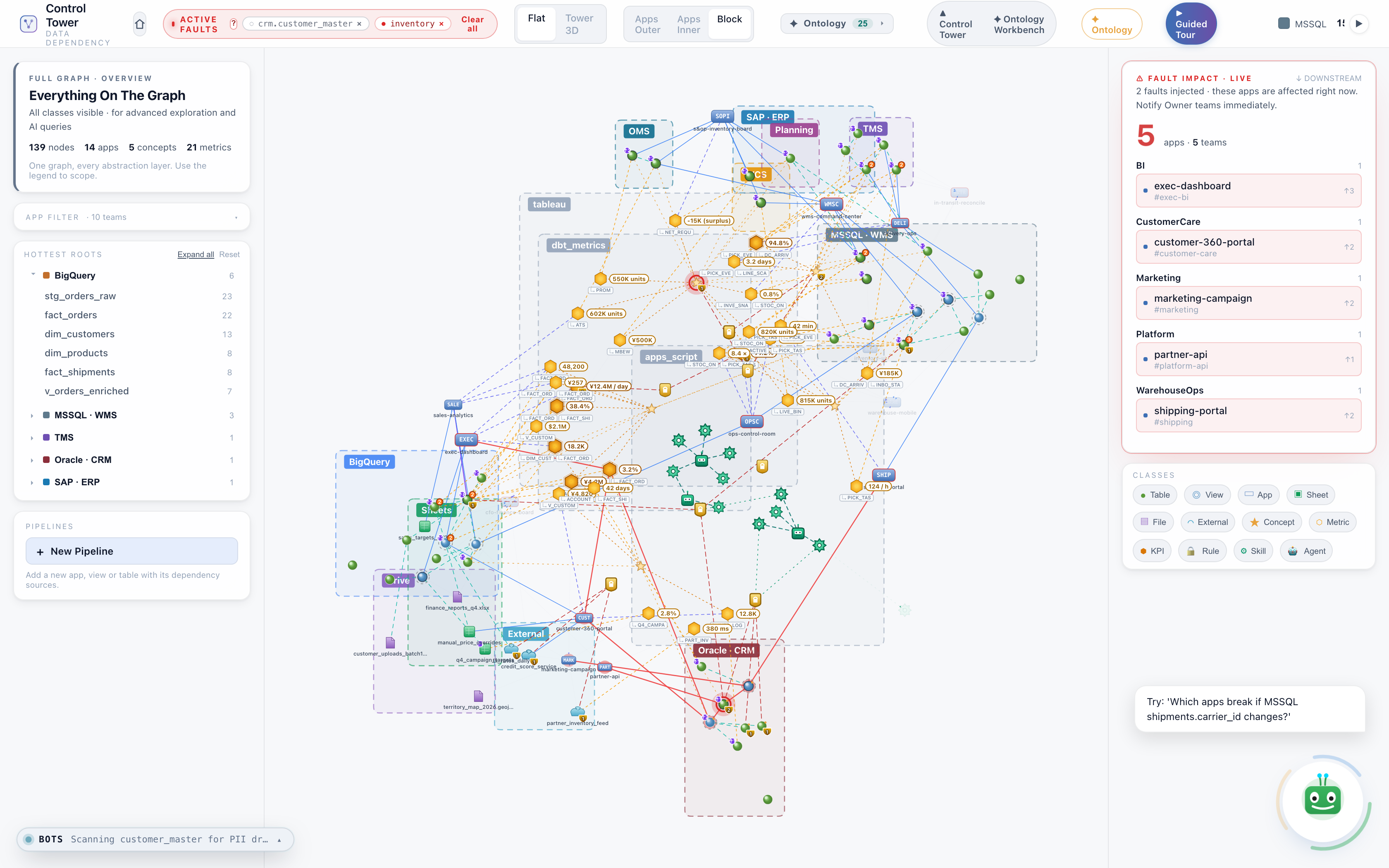
Any fault. Every downstream app. Three seconds.
Inject a broken node anywhere in the stack. The graph paints the blast radius forward, tells you every Slack channel to notify, and shows which KPIs are about to drift — before anyone files a ticket.
Run this fault live →Before you open a new pipeline — we show who's already doing it.
Ask Kai in plain language: "do we already track pick accuracy?" Kai ranks existing metrics, returns owner + channel, and the canvas badges the source table with ⚠ N fetchers so the reuse debt is visible on the map, not buried in a wiki.
Open the Reuse Advisor →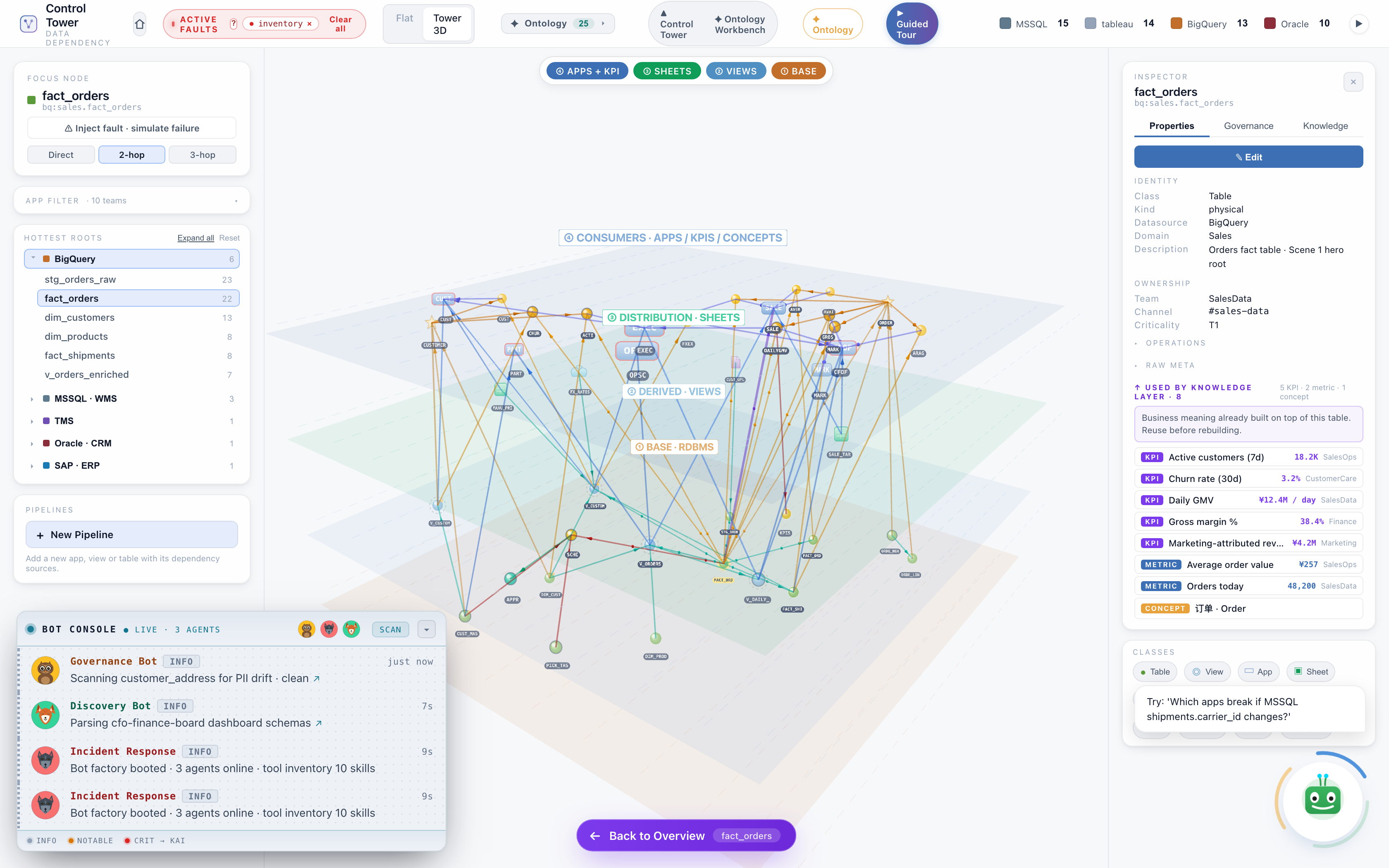
Policies live in the graph. Bots enforce them. Humans approve.
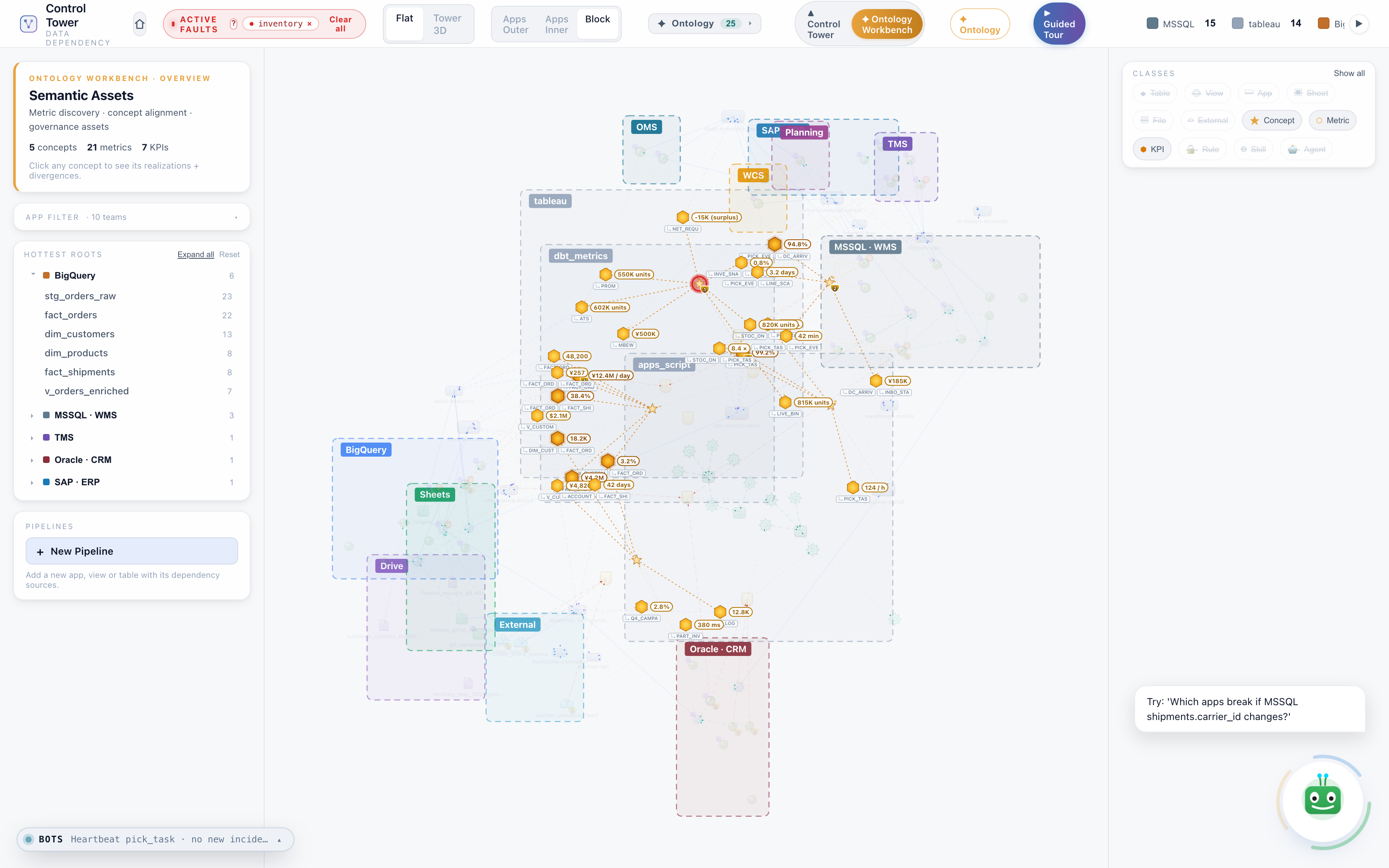
Every CONSTRAINS edge is a live policy. Governance Bot watches PII. Incident Response watches SLA. Discovery Bot promotes unowned metrics. Each proposes a remediation; a human approves; the accepted action becomes a node — the audit trail is the graph itself.
Open the Ontology Workbench →"What's our inventory?" has six correct answers. The graph holds all of them.
The concept inventory sits in the centre. Each branch is a real team's flavor — purchase, warehouse, finance, in-transit — each with its own owner and unit. When two realizations drift beyond policy, the incident is filed at the concept level, not on a random dashboard. This isn't a chart — it's a query agents can walk.
See the 6 faces of inventory →Graph-native by design.
So agents can reason over it — not just so humans can look at it. The visualisation is a byproduct.
No specialised databases, no bespoke clusters, no new infrastructure required to pilot.
Implementation is ours. The contract is yours.
Qualitative leaps today. A three-act evolution ahead.
Control Tower
Ontology
Autonomous
Every phase is additive. Phase 2 does not retire Phase 1 dashboards.